
Process guide
El Cajon Sprinklers: What to Expect at a Sprinkler Repair Visit in El Cajon
From the first call to the last zone test, so a stranger in your yard is not a surprise.
- El Cajon and East County9 nearby communities, all within 20 miles
- Licensed, insured local contractorsWe work with them; check any license at cslb.ca.gov
- Written price firstTypical ranges published on every service page
- Calls answeredMonday to Saturday, 7am to 6pm
El Cajon Sprinklers wrote this for El Cajon and East County homeowners who have not had a sprinkler repair visit before, or not for a while. It walks through what usually happens, what to have ready, and what you should expect to see in writing, so you can tell a well-run visit from one that is not.
The call
The first call is about narrowing down the problem. Expect to be asked what you see when the zone runs, whether the problem is on one zone or all of them, whether anything has been dug recently, how big the yard is, and who supplies your water. Calls through this site may be recorded; California requires everyone on a call to consent before it is recorded, so a notice plays first.
From that, you should get a likely cause and a typical price range. Ranges for every common job are on the cost guide. A visit is booked if the problem needs one, and most do.
Before the visit
- Know where the controller is, and how to get to it
- Find the valve boxes if you can, and clear anything stacked on them
- Unlock side gates and secure dogs
- Know where the irrigation shutoff or main water valve is
- Note which zone number covers the problem area, if the controller shows it
Water running where it should not? Describe what you see and get a price range on the phone.
Call (619) 361-7869The walk-through
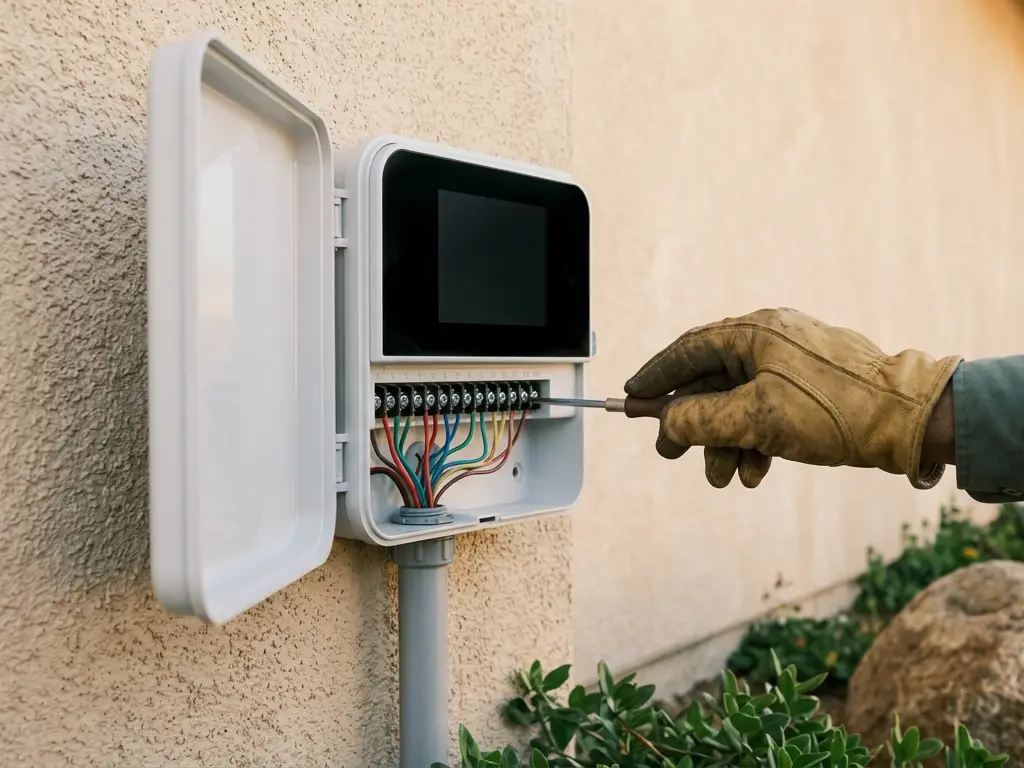
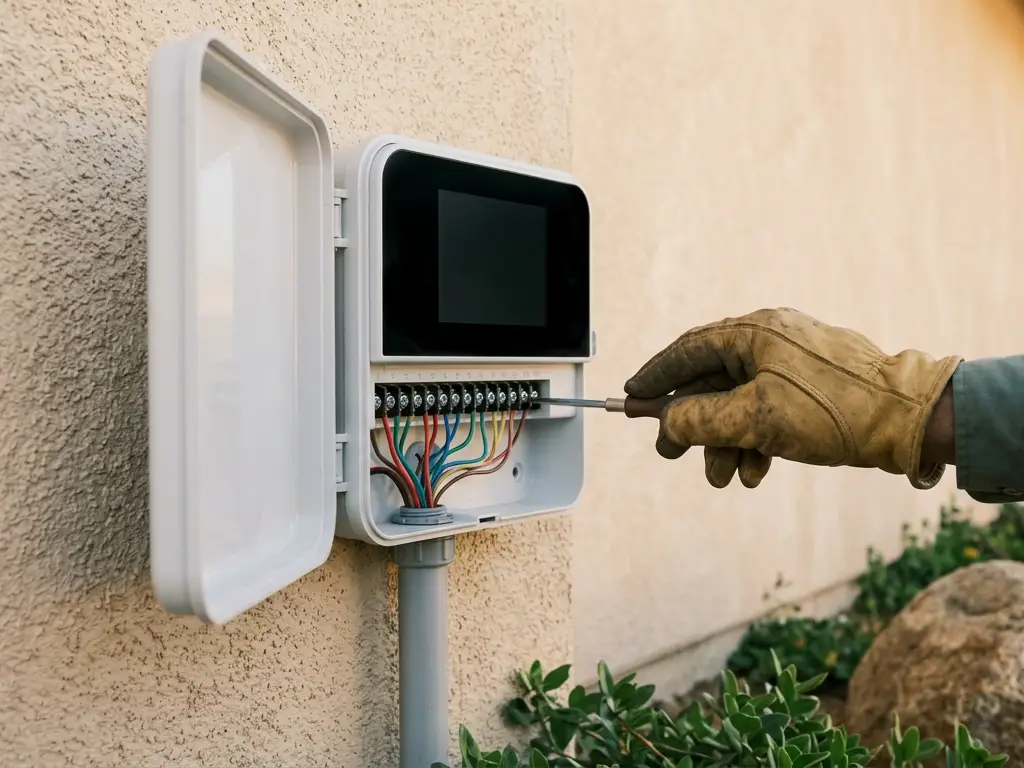
A good technician starts at the controller and runs each zone in turn, watching the heads, the coverage and the ground. That takes a few minutes per zone, and it is where most of the diagnosis happens. Expect them to point out what they see as they go: a broken head, a weak zone, overspray, a wet patch.
For a zone that will not start, expect a multimeter at the controller, and possibly a wire tracer in the yard. For a zone that will not stop, expect the valve box to be opened. For a suspected leak, expect the meter test with everything off. See sprinkler valve repair for what happens at the valve.
The written price
Before any work starts, you should see the price in writing, broken down enough to understand it: parts, labor, and anything that might change the number once the ground is open. A broken pipe on clay, for example, may need more digging than expected, and a good quote says so. Many companies have a minimum charge of $50 to $150, which is why it pays to fix several small things in one visit.
For any job over $1,000 in labor and materials, the contractor must be licensed in California, and irrigation work falls under the C-27 classification. It is reasonable to ask for the license number at this point and check it on the Contractors State License Board site.
The repair
Most repairs take one to two hours. A valve replacement typically takes 1 to 2 hours by HomeGuide's figures; a head swap is minutes. Pipe repairs depend on the soil: quick in sandy loam, slower in the Diablo clay mapped in Spring Valley, Santee and Lemon Grove, slower still near rock in Alpine. Expect the water to be off to the irrigation, not the house, while pipe is open.
Not sure which of these you are looking at? Most people are not. Call and describe it.
Call (619) 361-7869The test run and the hand-off
The repair is not finished until the zone runs and works. After a pipe repair, the zone should be flushed with the end heads off, so dirt from the break does not clog every nozzle downstream. Then each affected zone is run while you watch. A careful technician also checks the controller program against your supplier's rules: Padre Dam's 10-minute limit and morning or evening window for spray heads, Poway's 6 p.m. to 10 a.m. window, Helix's ban on runoff.
What you should leave with
- A written invoice that matches the written price, or explains why not
- A note of anything found that was not fixed, with a rough range
- The controller set for the season and for your supplier's rules
- Turf patched where pipe was dug
If the visit turns into a bigger job
Sometimes a repair visit finds more than the problem you called about: a manifold of old valves, a lateral that has cracked in several places, a backflow assembly due for its annual test. A good technician separates what has to be fixed now from what can wait, and prices them separately, so you can decide.
For a new system or a full zone rebuild, expect a second, longer visit. The contractor should measure the static pressure and the flow at the meter, map the yard, and design zones around them before giving a price, because those two numbers decide how many heads each zone can carry. A new in-ground system typically runs $3,000 to $10,000 for a quarter acre, and a quote for one that arrives without anyone measuring the water is worth questioning. If a backflow test is part of the job, ask whether the tester is approved by your water supplier, since each supplier keeps its own list.
When to call back
If the same zone misbehaves again within days, or a new wet spot appears near the repair, call the company that did the work first. A fitting that was not fully seated or a joint disturbed during digging usually shows up quickly.
Appointment questions
How long does a sprinkler repair visit take?
Most repairs take one to two hours, including running each zone before and after. Pipe repairs in clay take longer.
Do I need to be home for a sprinkler repair?
It helps for the walk-through and the test run, and someone needs to unlock gates and the controller.
Will my water be shut off?
Usually only the irrigation side, while pipe is open. A mainline repair may need the main valve closed briefly.
Should I get the price in writing?
Always, before work starts. Many companies charge a $50 to $150 minimum, so bundle small repairs into one visit.
What should I check after the repair?
Run the repaired zone again the next day, and watch for new wet spots near where the ground was opened.
Tell us which zone is acting up
Say what you are seeing (a geyser, a dry patch, a zone that will not shut off, a timer that went blank) and roughly how big the yard is. You will hear what the fix usually involves and what it tends to cost before anyone comes out.
Call (619) 361-7869