
Hillsides
El Cajon Sprinklers: Slope Irrigation in El Cajon and East County
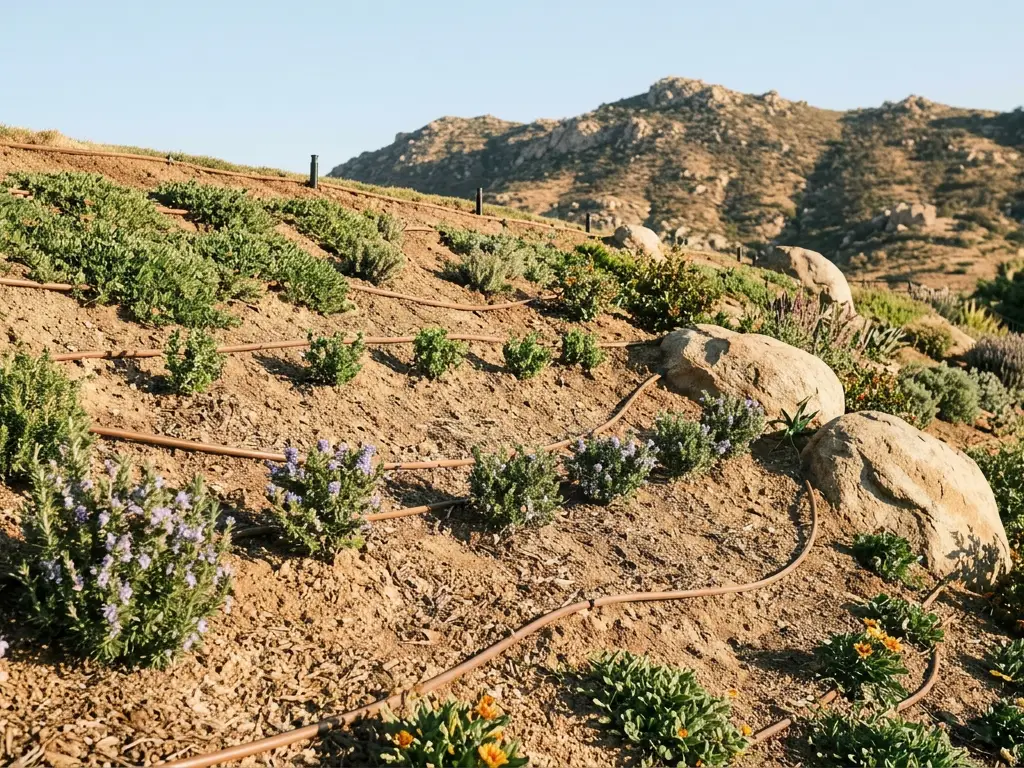
Banks, terraces and backyard hills, watered slowly enough that the water stays on the slope.
- El Cajon and East County9 nearby communities, all within 20 miles
- Licensed, insured local contractorsWe work with them; check any license at cslb.ca.gov
- Written price firstTypical ranges published on every service page
- Calls answeredMonday to Saturday, 7am to 6pm
El Cajon Sprinklers arranges slope irrigation for hillside yards in El Cajon and East County through local irrigation contractors. A slope is the hardest place in a yard to water well: gravity moves the water downhill faster than the soil can take it in, so a system that works on flat lawn can strip a bank of soil in one season.
A slope zone runs $600 to $2,000 to install properly; watered with ordinary spray heads, it sheds water and soil together, and repairing a washed-out bank and its broken lines costs more than the zone did, starting with $150 to $400 for every line the runoff undermines.
$600 to $2,000 per zone
Irrigating a slope in El Cajon typically costs $600 to $2,000 per zone (HomeGuide, February 2026), at the upper end of normal because rocky or sloped ground can reach $4.00 a square foot to install. Drip on the contour, with pressure-compensating emitters, is usually the lower-cost and lower-runoff choice.
Get a price: (619) 361-7869Signs a slope is being watered wrong
- Water sheeting down the face of the bank during a cycle
- Mud or decomposed granite washing onto the patio or driveway
- Plants at the top dry while plants at the bottom stay soggy
- Gullies forming along the fall line
- Heads at the bottom of the slope dribbling after the zone shuts off
Why slopes here are hard
The USDA soil survey maps the hillsides in Spring Valley and Lemon Grove as Diablo clay on 15 to 50 percent slopes, a clay that takes water at roughly an eighth of an inch an hour and swells and cracks with the seasons. Around Alpine the survey maps Cieneba rocky coarse sandy loam, with soft granitic bedrock about 8 inches down and rock outcrop across much of the unit. One soil sheds water because it cannot absorb it; the other because there is so little of it.
A fixed spray head applies about 1.5 inches an hour. On either soil, on any real grade, most of that runs off.
What works on a slope
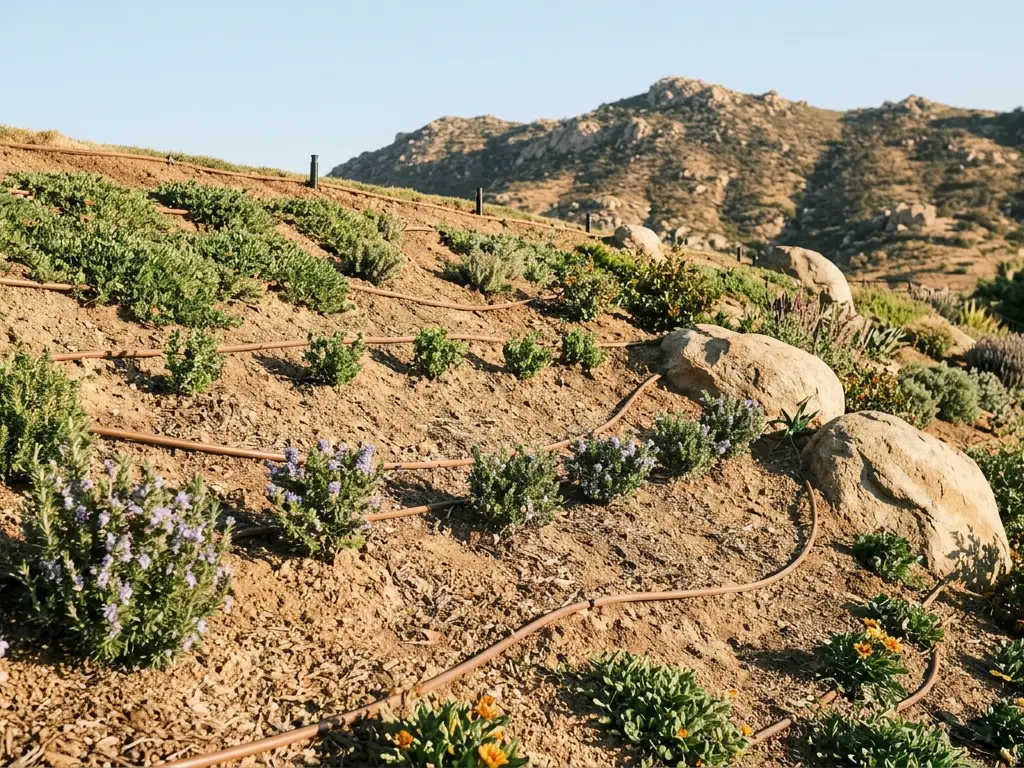
- Drip or dripline laid across the slope on the contour, not down it
- Pressure-compensating emitters, so the top and bottom of the bank get the same flow
- Check valves at low heads, so the zone does not drain out through the bottom heads
- Rotating nozzles at about 0.4 inches an hour where overhead water is needed, run in short cycles
- A separate zone for the slope, never shared with flat lawn
Run times on a slope should be split into several short cycles with a soak in between. Most current controllers do this automatically once the slope zone is set with its soil type and grade.
Water running where it should not? Describe what you see and get a price range on the phone.
Call (619) 361-7869The low-head drainage problem
When a zone on a slope shuts off, the water left in the pipe drains out of the lowest heads. That is called low-head drainage, and Helix lists it alongside runoff and overspray as water waste under its permanent rules. A check valve in the head or the riser holds the water in the pipe and stops it. It is one of the cheapest fixes on a hillside and one of the most often missed.
Access and cost
Slope work costs more mainly because of access: materials carried by hand, footing for the crew, and trenching on a grade or through rock. Drip laid on the surface under mulch avoids most trenching, which is why it is usually both the better system and the cheaper one on a bank.
Bank washing out?
Turn the slope zone off until it can be looked at. Call with the rough size of the slope and what is planted on it.
Call (619) 361-7869Slope irrigation questions
How much does slope irrigation cost in El Cajon?
Typically $600 to $2,000 per zone. Rocky or steep ground can reach $4.00 a square foot to install, mostly because of access.
Is drip or spray better on a slope?
Drip on the contour, with pressure-compensating emitters, in nearly every case. Where overhead water is needed, rotating nozzles at about 0.4 inches an hour in short cycles.
What are the signs my slope is overwatered?
Water sheeting down the face, mud on the patio, gullies along the fall line, and soggy plants at the bottom with dry ones at the top.
Why do the bottom heads keep dripping after the zone shuts off?
Low-head drainage: water left in the pipe drains out the lowest heads. Check valves fix it, and Helix treats it as water waste.
Can a slope share a zone with my lawn?
It should not. A slope needs shorter, repeated cycles and a different application rate from flat lawn.
Often done together
- Drip irrigation installationWater at the root, not on the wall: drip for beds, shrubs, trees, vegetables and anything on a slope.
- Rotating nozzle retrofitThe same heads, a slower nozzle, and water that soaks into clay instead of running down the gutter.
- El Cajon Sprinklers: Sprinkler Repair in AlpineRock outcrop, eight inches of soil over granite, and slopes where drip does what spray cannot.
Tell us which zone is acting up
Say what you are seeing (a geyser, a dry patch, a zone that will not shut off, a timer that went blank) and roughly how big the yard is. You will hear what the fix usually involves and what it tends to cost before anyone comes out.
Call (619) 361-7869