
Mistakes guide
El Cajon Sprinklers: Eight Sprinkler Mistakes That Cost El Cajon Homeowners
Most expensive sprinkler problems start as cheap decisions. Here are the ones that show up most.
- El Cajon and East County9 nearby communities, all within 20 miles
- Licensed, insured local contractorsWe work with them; check any license at cslb.ca.gov
- Written price firstTypical ranges published on every service page
- Calls answeredMonday to Saturday, 7am to 6pm
El Cajon Sprinklers sees the same handful of decisions behind most costly sprinkler calls in El Cajon and East County. None of them is unusual, and each is cheap to avoid. They are listed roughly in the order they cost money, with the fix for each.
1. Mixing spray and rotating nozzles on one zone
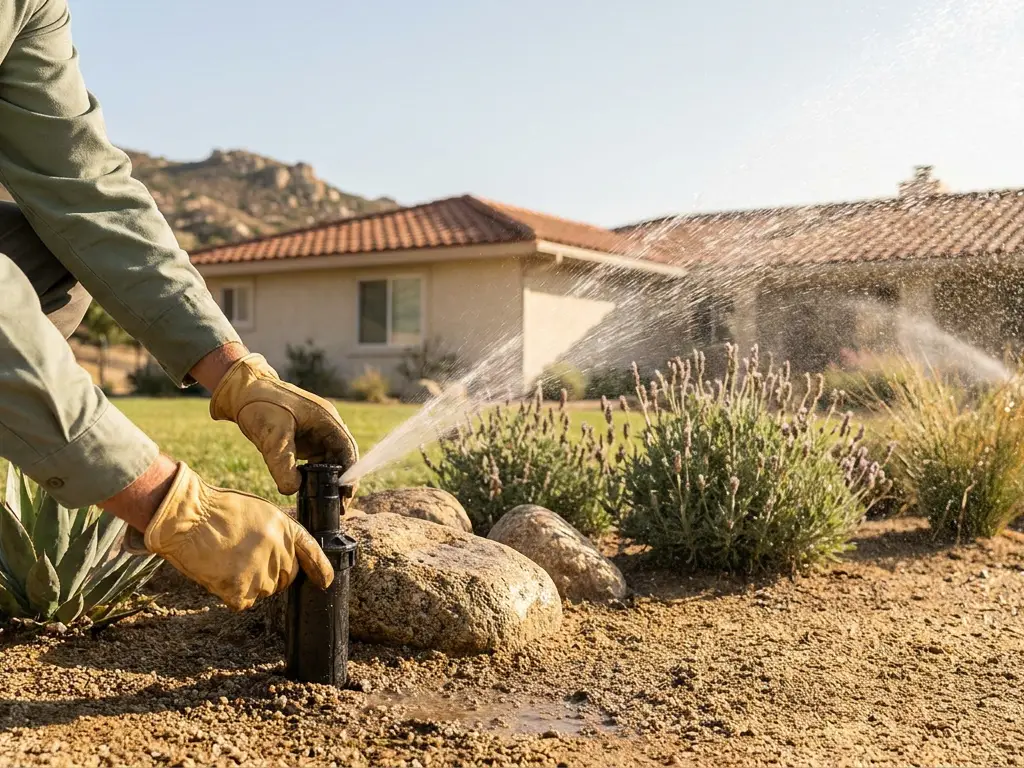
A fixed spray nozzle puts down about 1.5 inches an hour; a rotating nozzle about 0.4, by the manufacturer's figures. When a broken spray head is replaced with whatever is on hand, or a few rotating nozzles are added to a spray zone, one part of the zone floods while the other stays dry. The fix is to keep each zone to one nozzle type, and to convert a zone all at once.
2. One long cycle on clay
The USDA soil survey maps central El Cajon as sandy loam over a clay subsoil about 13 inches down, and much of Santee, Spring Valley and Lemon Grove as Diablo clay from the surface. A single 20-minute spray cycle on either sends a share of the water into the gutter. Every supplier around El Cajon prohibits runoff. Split the same minutes into two or three cycles with a soak between, and the water goes into the ground.
Water running where it should not? Describe what you see and get a price range on the phone.
Call (619) 361-78693. Spray heads on beds that used to be lawn
When a lawn becomes a planted bed, the old lawn heads often stay, now wetting walls, paths and the gaps between plants. Converting that zone keeps the valve and pipe and costs $1.50 to $4.50 a square foot; leaving it costs water on every cycle and invites the wet-footing and runoff problems that follow. See spray to drip conversion.
4. Ignoring a weeping valve
A valve that lets a little water through after the zone shuts off drains the zone through its lowest head, every time, for months. It looks like a small wet spot. It is a $70 to $300 repair, and left alone it keeps soil around the pipe saturated, which is how small leaks become broken lines.
5. Never cleaning the filter or flushing drip
Helix's 2024 water quality report puts average hardness at about 12.5 grains per gallon. That mineral load settles in filter screens and emitter outlets. A drip zone with a packed filter and crusted emitters runs on schedule while the plants at its far end go dry. Rinse the screen and open the end caps once a season.
Not sure which of these you are looking at? Most people are not. Call and describe it.
Call (619) 361-78696. Leaving the summer schedule on all year
El Cajon averages about 11.6 inches of rain a year, mostly in the cooler months, and summer highs near 86 degrees. A controller set in August and never touched again overwaters for half the year, and keeps running through the 48 hours after rain that every local supplier says to skip. A rain delay and seasonal adjustment, or a weather-based controller with the $80 SoCal Water$mart rebate, fix it. See smart irrigation controller installation.
7. Digging without knowing where the lines run
Fence posts, new beds and tree planting are the top causes of cut sprinkler wire and broken lateral pipe. Before digging, find the valve boxes and run each zone to see where its heads are; pipe usually runs in straight lines between heads and back to the valve. A cut wire costs $60 to $100 to repair and a broken pipe $150 to $400, both avoidable.
8. Hiring on price alone for a big job
For any job over $1,000 in labor and materials, California requires a licensed contractor, and irrigation falls under the C-27 classification. The cheapest bid on a new system is often one that skipped measuring pressure and flow at the meter, which is the one measurement that decides how many heads a zone can carry. Ask for the license number, check it on the Contractors State License Board site, and ask how the zones were sized.
What these mistakes cost, added up
Put the published numbers side by side and the pattern is clear. Avoiding most of these mistakes costs a maintenance visit at $80 to $180, a few heads at $65 to $90 each, or a controller at $155 to $329 before an $80 rebate. Leaving them costs a valve at $70 to $300, a broken pipe at $150 to $400, a backflow replacement at $450 to $1,700, and eventually a new system at $3,000 to $10,000 for a quarter acre, all HomeGuide's February 2026 figures except the controller. A system that lasts its full 15 to 25 years is usually one that was looked at once a year.
The local version of these mistakes
Some of these cost more in particular places. In La Mesa, where the survey maps a clay layer about 15 inches down, long cycles waterlog roots. In Santee and Alpine, Padre Dam's 10-minute standing limit on spray heads makes cycle-and-soak programming a requirement rather than a refinement. On Mount Helix and other hillside lots, missing check valves at low heads drain every zone downhill after it shuts off.
A short checklist
- One nozzle type per zone, and lawn never on the same valve as shrubs
- Short cycles with soaks on any clay soil
- Drip, not spray, within 24 inches of pavement and walls
- Filter rinsed and drip flushed every season
- Controller adjusted with the seasons, and off for 48 hours after rain
- A license number on file for anyone doing work over $1,000
Mistake questions
What is the most common sprinkler mistake?
Running one long cycle on clay soil, which sends water down the street. Split it into short cycles with soaks between.
Can I put a different sprinkler head on a zone?
Only if it matches the others in type and application rate. Mixing spray and rotating nozzles floods one area and starves another.
Why does my yard flood after watering?
Usually cycles too long for the soil, or spray heads where drip belongs. On clay, short cycles fix most of it.
How often should I clean my irrigation filter?
At least once a season, more often with hard water. Flush drip lines through the end caps at the same time.
Is it worth fixing a small leaking valve?
Yes. It is a $70 to $300 repair, and left alone it keeps the soil around the pipe saturated until something breaks.
Tell us which zone is acting up
Say what you are seeing (a geyser, a dry patch, a zone that will not shut off, a timer that went blank) and roughly how big the yard is. You will hear what the fix usually involves and what it tends to cost before anyone comes out.
Call (619) 361-7869